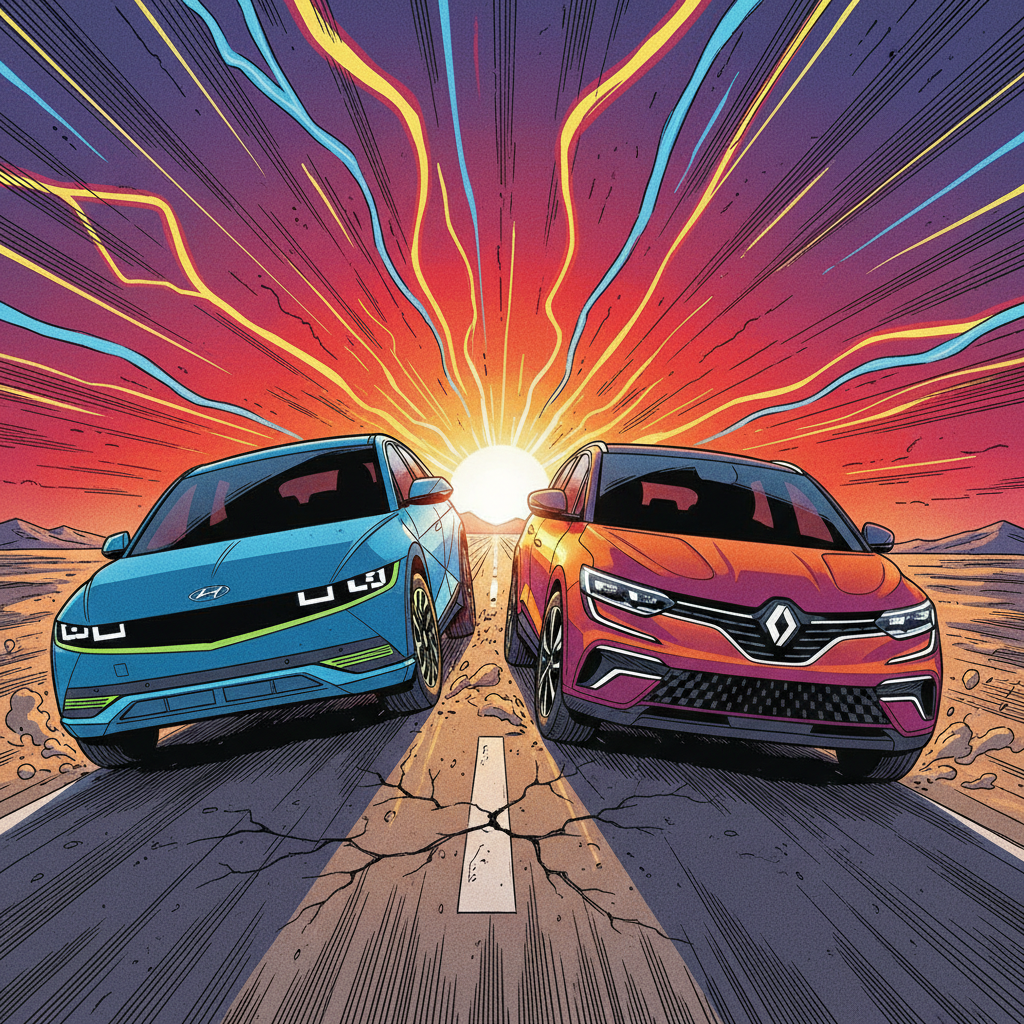
Hyundai Ioniq 5 vs Renault Scenic E-Tech: The Family EV Shootout
Part of an ongoing series: The Champion Family EV — Great Car, Not a Great Mortgage.
Two cars kept rising to the top of my research: the Hyundai Ioniq 5 vs Renault Scenic E-Tech — a comparison.
I have spent an unreasonable amount of time researching family electric cars. Not a casual browse. Not a quick Google. A proper, obsessive, comparison-spreadsheet deep dive that my wife has started referring to as “the thing.” This is the thing.
Two cars kept rising to the top: the Hyundai Ioniq 5 and the Renault Scenic E-Tech. On paper they look almost identical — similar battery sizes, similar range, similar price bracket. Spend five minutes with a spec sheet and you’d be forgiven for thinking they’re essentially the same car wearing different badges. They’re not. One key difference — what happens when you plug them in — tells you almost everything about how these two approach the job of being a family EV.
Here’s how they actually stack up.
Hyundai Ioniq 5 vs Renault Scenic E-Tech: The Specs That Actually Matter
| Feature | Hyundai Ioniq 5 (Long Range) | Renault Scenic E-Tech (Long Range) |
|---|---|---|
| Usable Battery | 84 kWh | 87 kWh |
| Official WLTP Range | Up to 354 miles | Up to 379 miles |
| Real World Range (Octopus EV) | ~240 miles | ~300 miles |
| Max DC Charging Speed | 260 kW (800V architecture) | 150 kW (400V architecture) |
| 10% to 80% Charge Time | ~18 minutes | ~38 minutes |
| Boot Space | 527 litres + frunk | 545 litres (no frunk) |
| Infotainment | Hyundai Bluelink (physical HVAC buttons) | Google built-in (OpenR Link) |
| Buy Price (from) | ~£40,700 | ~£37,000 |
| 0% APR Finance | Yes — no minimum deposit | Yes — but requires 30% deposit (~£11k+) |
| Octopus EV Full-Service Lease | From £439/mo | From £469/mo |
1. Range & Charging: One Big Number, One Big Speed
The batteries are close — 84 kWh vs 87 kWh — and on WLTP figures the Scenic edges ahead with 379 miles to the Ioniq 5’s 354. In real-world terms, Octopus EV estimates roughly 300 miles for the Scenic against 240 for the Ioniq 5. That’s a more meaningful gap. On a long family run, the Scenic is likely to reach the destination without a charging stop that the Ioniq 5 would need.
But — and this is the whole conversation — when the Ioniq 5 does stop, it’s done in 18 minutes. The Scenic takes 38. Find an ultra-rapid 350 kW charger and the Ioniq 5 goes from 10% to 80% in roughly the time it takes to shepherd two children through a motorway services, negotiate snacks, and get everyone back in the car. The Scenic is still charging when you pull away.
Which matters more depends entirely on how you drive. Lots of long motorway runs? That charging speed is transformative. Mostly school runs, commutes, and the occasional weekend away? The Scenic’s extra range means you might never need a rapid charger at all.
2. Cabin & Practicality: Spaceship vs. Clever Family Hack
The Ioniq 5’s interior is genuinely unusual in the best possible way. Built on a dedicated EV skateboard platform with a 3-metre wheelbase, the floor is completely flat, the centre console slides, and the rear legroom is enormous. There’s a frunk (front boot) for keeping cables away from the actual boot, a 3.5 kW Vehicle-to-Load socket for powering laptops or camping gear, and a cabin that feels more like a well-designed flat than a car. It’s 527 litres of boot space with seats up, expanding to 1,587 litres flat.
The Scenic takes a more traditional SUV approach — familiar, reassuring, immediately comfortable — but compensates with some genuinely smart thinking. The rear armrest folds out to reveal tablet stands, two USB-C ports, and cupholders built specifically to stop children complaining on the M6. The boot is marginally bigger at 545 litres, though without a frunk, your charging cables live under the boot floor with everything else.
Both are genuinely practical. The Ioniq 5 feels more futuristic. The Scenic feels more considered for family life specifically.
3. Tech: The One Where Renault Wins Convincingly
The Scenic runs Google’s OpenR Link system — Android Automotive built natively into the dashboard. Real Google Maps. Google Assistant. EV route planning that calculates your battery percentage on arrival rather than making an optimistic guess that unravels somewhere near junction 15. It is fast, intuitive, and — rare words for car infotainment — it just works.
The Ioniq 5 facelift is polished and capable, and crucially retains physical buttons for climate and heated seats. That sounds minor until you’ve tried to adjust the fan speed on a dual carriageway through three submenus. Hyundai’s route planning is good. It’s not Google Maps good.
4. The Money: Where It Gets Interesting
On sticker price, the Scenic is around £3-4k cheaper — roughly £37,000 vs £40,700 for comparable long-range specs. Both offer 0% APR finance, but the devil is in the detail. Hyundai’s deal comes with no minimum deposit requirement — just a £2,000 deposit contribution from them to sweeten it. Renault’s 0% offer requires a 30% minimum deposit. On a £37,000 car, that’s over £11,000 upfront. For most families that’s not a finance deal, it’s a savings target.
On leasing, the gap narrows considerably. Via Octopus EV on a fully-inclusive personal lease (servicing, maintenance, home charger, breakdown), the Ioniq 5 comes in from £439/mo and the Scenic from £469/mo. That £30/mo difference over four years is £1,440 — real money, but not the deciding factor it might appear on a sticker price comparison.
The lease route is also worth taking seriously beyond the monthly figure. Octopus EV’s personal lease bundles in the home charger installation — which, if you’re moving house or buying new, is a meaningful saving in itself.
The Verdict
Choose the Ioniq 5 if: you do frequent long motorway runs where charging stop time genuinely matters, you want the most futuristic cabin experience in this price bracket, and Hyundai’s accessible 0% finance deal suits your situation. The 800V charging architecture is a real superpower — just one that only reveals itself on longer journeys.
Choose the Scenic E-Tech if: you want the best real-world range in this class, prefer Google built natively into the dash, have kids who will absolutely exploit that rear armrest, and either have the deposit for Renault’s 0% deal or plan to lease. It’s the pragmatist’s choice — and at £3-4k less to buy, it’s a meaningful saving you can put towards the home charger installation you’ll need anyway.
Both are excellent. Both are overthought. Next up: the Skoda Enyaq — and whether “sensible” is actually the right answer all along.